Key Takeaways
- An ATS score is a 0–100% match rating between your CV and one specific job ad - not a universal CV quality score.
- Most tools recommend aiming for at least 75–80% keyword and skill match before submitting; below 60% usually means rework.
- Recruiters don't see the score from external tools like Jobscan - treat it as a diagnostic, not a final verdict.
- Parseability (simple layout, standard headings, PDF/DOCX) matters as much as keywords for getting through ATS filters.
What Is an ATS Score and Does It Matter for Your CV: The Honest Guide
Your ATS score is the number that promises to predict whether your CV gets read or buried - but most candidates misunderstand what it actually measures. This guide explains exactly what an ATS score is, how it's calculated, what counts as a good result, and whether you should care about the number at all.
What Is an ATS Score?
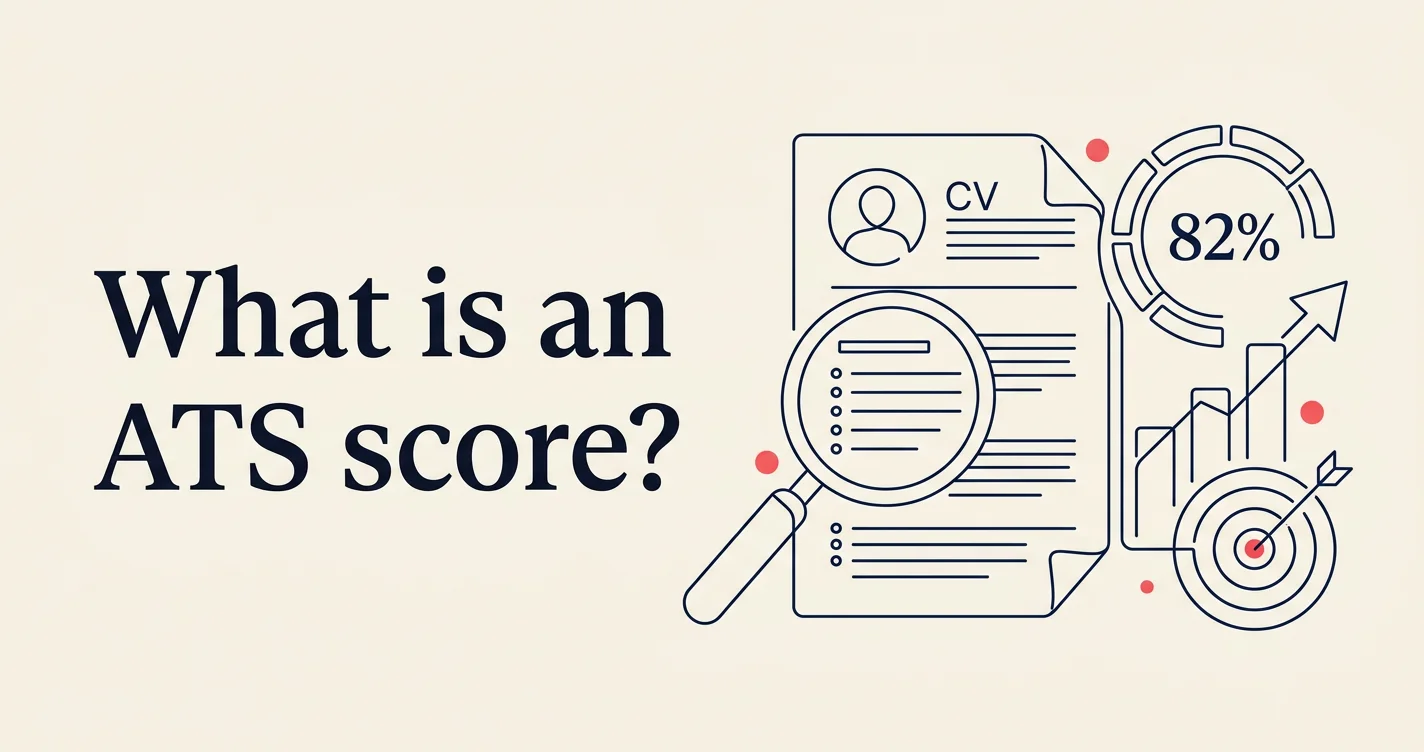
An ATS score is a numerical compatibility rating, usually expressed as a percentage from 0 to 100%, that shows how well a CV matches the requirements of one specific job advert. It's calculated by an Applicant Tracking System or an external tool based on keyword overlap, skills alignment, job title relevance and CV formatting.
The critical detail most people miss: an ATS score is a job-specific compatibility rating, not a universal quality grade for your CV. The same document can score 92% for one role and 41% for another - because each job ad has different keywords, required skills and seniority signals.
There's also no single "official" ATS score. Most scores candidates see come from third-party simulators (Jobscan, Resume Worded, Kickresume), not from the recruiter's actual system. The employer's ATS - whether it's Workday, Greenhouse, Teamtailor or eRecruiter - usually applies its own filters and rankings that you never see. Related concepts you'll bump into are keyword match (how many job-ad terms appear in your CV), parseability (whether the ATS can read your file at all), and applicant ranking (the internal recruiter-side ordering, which is separate from any external score).
How Is an ATS Score Calculated?
Most ATS scoring tools combine two core components - keyword match and parseability - into one final percentage. Here's what goes into the number:
- Keyword match. The tool compares words and phrases from the job ad (skills, technologies, certifications, job titles) against your CV. The simplest formula: matched keywords ÷ total required keywords × 100. If 12 of 16 required terms appear in your CV, your keyword match is 75%.
- Skills and qualifications alignment. Beyond raw keywords, modern checkers look at whether you actually demonstrate the required skills in context - for example, "managed a team of 8" versus just listing "leadership".
- Job title relevance. "Software Engineer" matches the ad; "Coding Rockstar" doesn't. ATS systems rely on standard titles to classify experience.
- Parseability. This is the system's ability to read your CV. Multi-column layouts, tables, text boxes, icons, images and unusual fonts can break parsing - even if your keywords are perfect.
- Section structure. Standard headings like Summary, Skills, Work Experience and Education help the ATS map your content correctly. Creative names like "My Journey" can leave entire sections unread.
What Counts as a Good ATS Score?
Different tools use slightly different ranges, but the benchmarks below are consistent across the major checkers. If you want to skip the guesswork, you can check your CV's ATS score for free and see exactly which band you fall into.
| ATS Score | Interpretation | Recommended action |
|---|---|---|
| 90–100% | Excellent - almost certain to pass initial ATS filtering | Submit; minor polish only |
| 75–89% | Good - strong chance of reaching a recruiter | Submit, optionally tweak missing keywords |
| 60–74% | Borderline - noticeable gaps in match | Rework before sending |
| Below 60% | High risk of automatic rejection | Major rewrite needed |
Typical, untailored CVs often land in the 60–70% range - which is exactly why generic CVs underperform. Tools like Jobscan and Resume Worded typically recommend pushing priority applications to at least 75–80% before hitting submit.
Does ATS Score Actually Matter?
Yes - but probably less than the tools selling you a score want you to believe. Here's the honest breakdown:
- It matters for visibility. A higher score means your CV is more likely to be parsed correctly, surface in recruiter keyword searches, and rank well in the internal pipeline.
- It doesn't guarantee an interview. Recruiters at companies using ATS systems like Workday or Greenhouse never see the score from your Jobscan report. Real hiring decisions still come down to relevant experience, achievements and human judgement.
- It's diagnostic, not predictive. Treat the score the way a doctor treats a blood test: useful for spotting problems, not a final diagnosis.
Imagine you're applying to a corporate role at a large bank. Their ATS (say, SAP SuccessFactors) ranks applicants based on the recruiter's chosen keywords. Your external Jobscan score of 88% suggests you're well-aligned - but the recruiter sees only their internal ranking, plus your CV. If your achievements look thin compared to other 88%-scorers, you still won't get the call.
ATS Score vs CV Quality: What's the Difference?
| Criterion | ATS Score | Overall CV Quality |
|---|---|---|
| Measures | Match to one specific job ad | General professionalism and clarity |
| Audience | Software (ATS) | Human recruiter |
| Universal? | No - changes per job | Yes - stays roughly the same |
| Key drivers | Keywords, parseability, titles | Achievements, structure, writing |
| Risk of gaming | High (keyword stuffing) | Low |
The takeaway: optimising for ATS score alone is a trap. A CV that scores 95% through keyword stuffing but reads like a robot wrote it will be rejected the moment a human opens it.
How Do You Improve Your ATS Score Without Ruining Your CV?
- Print the job ad and highlight every required skill, tool and title. Then do the same with your CV. Count the overlap. Below 75%? Add the missing terms - but only where they're genuinely true.
- Use a single-column layout with standard section names. Summary, Skills, Work Experience, Education. No tables, no text boxes, no icons.
- Save as PDF or DOCX. Avoid scanned PDFs, Pages files, or anything image-based. Use Arial or Times New Roman in a standard size.
- Match exact job titles. If the ad says "Data Analyst", don't write "Insights Specialist" - at least not as your primary title.
- Avoid keyword stuffing. Repeating "project management" eight times will tank your readability without meaningfully boosting your score with modern parsers.
- Re-test before submitting. Run your tailored CV through an ATS checker every time you apply for a priority role.
If you want a deeper analysis than a basic score gives you, you can get your CV reviewed by AI for tone, structure and missing achievements - or browse ATS-optimised templates that handle the parseability side for you.
Summary: Should You Care About Your ATS Score?
Care about it the way you'd care about a smoke detector - useful as a warning, useless as a strategy. Aim for 75–85% on priority applications, fix obvious parsing issues, then put your energy into achievements, networking and tailored content. That combination beats any score in isolation.
Ready to see where your CV stands? Run it through the free CVCompose ATS checker and find out in under 30 seconds.
About the Author
CVCompose
CV building and optimisation tool
CVCompose helps candidates get through ATS systems and land more interviews. Our tools - from ATS score checkers to AI-powered CV reviews - are built on analysis of hundreds of thousands of applications and current recruitment trends.