You have spent an afternoon polishing your CV, tailored the personal statement, and finally hit send on that application to a New York firm. Two weeks pass. Nothing.
In many cases like this, the problem is not your qualifications. It is the format.
Sending a European CV to an American employer is one of the most common - and most easily avoidable - mistakes internationally minded candidates make. This article explains exactly what sets a CV apart from a resume, where each document belongs, and how to adapt your existing materials when you need to switch markets.
1 page
The standard length for a resume sent to US and Canadian employers - regardless of experience level
What Is a CV and Where Is It Used?
In the UK, the word "CV" (short for curriculum vitae, Latin for "course of life") is used for virtually every job application. It typically runs to two pages for experienced professionals and covers your employment history, education, key skills, and - unlike the American resume - can include personal details such as your address and, historically, a photograph.
European CVs, particularly in Germany, France, and the Netherlands, tend to be even more structured. The EU-standardised Europass CV format is widely used across continental Europe for cross-border applications, though it is not expected in the UK and can look overly bureaucratic to British recruiters.
What all European CVs share is their function: a comprehensive record of your professional and academic background, adapted minimally (or not at all) from one application to the next.
Where a CV is the expected format:
- United Kingdom
- Ireland
- Germany, France, Netherlands, Spain, Italy
- Australia and New Zealand
- Academic and research roles worldwide
What Is a Resume and Why Does the US Not Ask for a CV?
In the United States and Canada, the word "CV" is almost exclusively reserved for academic, medical, and research roles. Everyone else sends a resume - and the conventions are strict.
A resume is not a summary of your career. It is a targeted argument for why you are the right person for this specific role. Every word is chosen with that in mind.
The rules American recruiters apply:
- One page for candidates with fewer than ten years of experience. This is not a preference - it is a norm. A two-page document from a mid-career professional reads as an inability to edit.
- No photograph. Adding a photo to a resume in the US is widely seen as a red flag. US equal employment law (Title VII) means employers are extremely cautious about anything that could indicate knowledge of a candidate's race, age, or appearance before the interview.
- No personal details beyond contact information. Date of birth, marital status, nationality, and home address are all omitted. Name, email, phone number, and city are sufficient.
- Achievement-led bullet points. Every entry in your work history should tell the reader what you accomplished, not what you were responsible for. Numbers are expected.
- Tailored to every application. Sending the same resume to fifty employers is treated as a failure of effort. US hiring culture expects the document to reflect the specific language of the job description.
Key Differences at a Glance
| Feature | CV (UK / Europe) | Resume (US / Canada) |
|---|---|---|
| Length | 2 pages typical (no strict limit for academia) | 1 page (2 for senior roles) |
| Photo | Uncommon in UK; standard in Germany | Never |
| Personal details | Name, address, sometimes DOB | Name, email, phone, city only |
| Purpose | Full career history | Targeted pitch for one role |
| Bullet point style | Responsibilities and scope | Achievements with numbers |
| Tailoring | Light; same document for multiple roles | Heavy; rewritten for each application |
| Where it is expected | Europe, UK, Australia | USA, Canada |
| Academic use | Academic CV (extended) | Academic CV (not resume) |
Note on the UK: British employers use the word "CV" but expect something closer in spirit to an American resume than to a German Lebenslauf - typically two pages, no photo, and increasingly results-focused. If you are applying to a British company, a well-written two-page CV is correct. If you are applying to a US company's London office, it is worth asking whether the role is being reviewed by a US or UK hiring team.
Cover Letter vs Cover Letter - Not Quite the Same Either
The cover letter (called a covering letter in British English) is alive and well in the UK, particularly in finance, law, the public sector, and any role where written communication matters. Most UK job postings either request one explicitly or expect it as part of a complete application.
In the US, the picture is different:
- Large corporations: Cover letters are frequently optional and sometimes not read at all when applications arrive through ATS portals.
- Start-ups and smaller firms: A well-written cover letter can genuinely differentiate you, especially when applying directly to a hiring manager rather than through a portal.
- The safe rule: If the posting asks for one, send one. If it does not, a brief, targeted email body can substitute.
A US-market cover letter should open with a concrete statement, not a pleasantry. Start with what you bring, not with "I am writing to apply for..."
70%
of US recruiters do not read the cover letter if the resume does not meet the core requirements (Jobvite)
How to Convert Your UK CV into an American Resume
If you have a polished UK CV and need to apply to a role in the US - or at an international company with US-based hiring - here is a practical checklist:
1. Remove your photograph.
Even if your professional headshot is excellent, it does not belong on a resume. Remove it without exception.
2. Strip back the personal details.
Remove your full address and date of birth. Keep your name, email, phone number, and city (or "London, UK" if you are open to relocation).
3. Cut to one page.
This is the hardest edit. Keep the last ten years of experience. For each role, retain three to four of your strongest bullet points - the ones that contain numbers and outcomes. Everything else goes.
4. Rewrite responsibilities as achievements.
Change "Responsible for key account management" to "Managed 14 key accounts with combined annual revenue of £3.2M, retaining 96% year-on-year." Every bullet should answer: so what?
5. Remove any GDPR or data consent clause.
This is a UK and EU convention that is meaningless - and looks confusing - in the US context.
6. Mirror the language of the job posting.
Read the job description carefully. Identify five to eight phrases the employer uses consistently and make sure they appear naturally in your resume. ATS software scores keyword density before a human sees anything.
If you want to skip the manual reformatting, CVCompose offers resume templates built specifically for the US and international market - single-column, ATS-tested, and without the personal detail fields that do not belong in an American application. You can start from your existing CV and adapt section by section.
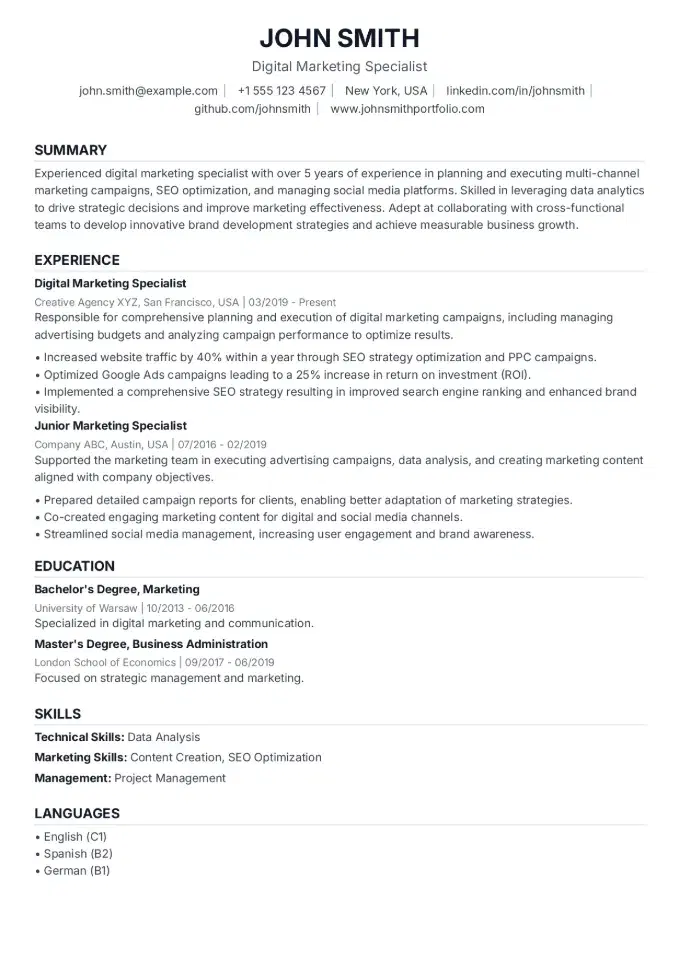
Like this layout?
Try the Essential Clean template - Click to fill it with your data
Essential Clean