When you sit down to write your first CV, the same thought hits everyone: what on earth am I going to put in it?
The work history section is blank. That's fine - and expected. Recruiters looking at applications from school leavers and students are not comparing you against candidates with ten years of experience. They're looking for initiative, engagement, and evidence that you're the kind of person who shows up and gets things done.
This guide will show you how to turn what you already have into a CV that gets noticed.
73%
of employers hiring entry-level candidates prioritise attitude and willingness to learn over existing skills (LinkedIn Workforce Report, 2024)
No Experience Isn't a Dealbreaker
Let's clear this up first: "nothing to put on your CV" isn't true for most people. If you've done anything beyond sitting in a classroom - you have material.
Experience on a school leaver or student CV doesn't mean "months of paid employment". What counts:
- school and university activities and societies
- personal or group projects
- volunteering and community involvement
- any regular work, paid or otherwise
- self-taught skills - languages, software, online courses with certification
Your CV at this stage isn't proving you've held down a job. It's showing that you're someone who does things, learns things, and goes beyond the minimum.
One specific fact is worth more than ten adjectives. "I'm hardworking and a great communicator" appears on almost every student CV and tells a recruiter nothing. "Grew the school's Instagram from 180 to 1,400 followers over one academic year by planning and scheduling weekly content" - that's memorable, specific, and demonstrates real capability.
How to Make Your Education Section Stand Out
On a CV with no work experience, Education moves to the top - directly below your contact details and personal statement. It's your strongest section, and "Northgate Sixth Form College, A-levels, 2023-2025" is not nearly enough.
What's worth adding alongside your school or university:
- A-level or BTEC subjects (with grades if strong)
- Degree title and university, with expected graduation year if still studying
- Dissertation or major project title - if it's relevant to the role
- Academic awards: scholarships, prizes, subject competitions, selection for gifted and talented programmes
- Strong predicted or achieved grades - include them if they're 3 A's at A-level equivalent or above; if not, leave them out
Compare these two entries side by side:
| Weak | Strong |
|---|---|
| Northgate Sixth Form, A-levels, 2023-2025 | Northgate Sixth Form, 2023-2025. A-levels: Mathematics (A*), Computer Science (A), Business Studies (B). EPQ on machine learning in healthcare logistics. UKMT Intermediate Maths Challenge - Gold. |
Same school. Same years. Completely different impression.
Volunteering, Clubs, and School Projects - Your Biggest Assets
This is your experience section. Genuinely.
Every extracurricular activity, society, community project, or school initiative is material for an "Experience" or "Activities & Projects" section. Use exactly the same format you'd use for a paid job: role + dates + what you did + any measurable result.
Here are concrete examples of translating everyday activity into CV language:
"I ran the school's TikTok" → Social Media Manager - School TikTok Account (Sep 2023 - Jun 2024). Created and edited short-form video content, planned weekly posting schedule, tracked engagement analytics. Account grew from 90 to 1,800 followers.
"I did volunteering at an animal shelter" → Volunteer - RSPCA Regional Shelter (2022 - present). Weekly 5-hour shifts: animal care, kennel cleaning, welcoming and advising potential adopters. Completed formal animal behaviour training (2023).
"I was in the school council" → Year 12 Student Council Representative - Northgate Sixth Form (2023-2024). Represented 180 students in termly meetings with senior leadership. Co-organised two fundraising events raising £640 for school charity.
"I did the Duke of Edinburgh Award" → Duke of Edinburgh's Award - Gold Level (2022-2024). Led 3-day expedition navigation in the Lake District. Volunteered 12 months at local foodbank as service component.
The pattern is always the same. If you can remember any number - how many people attended, how many hours per week, what the fundraising total was, how much the following grew - include it. Numbers stand out even when they're small, because they show you understand what a result actually looks like.
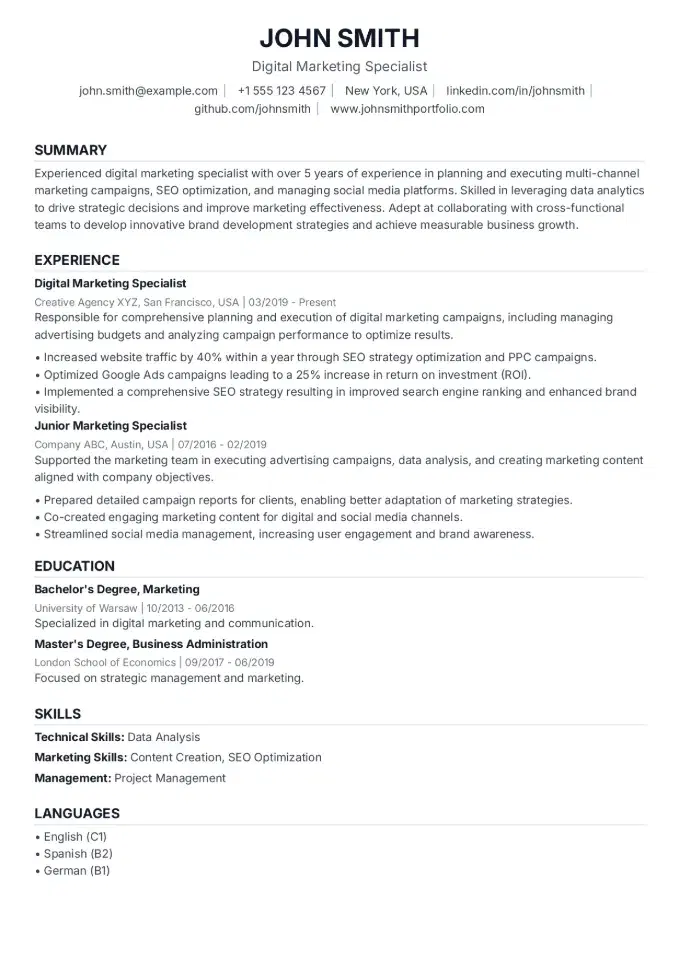
Like this layout?
Try the Essential Clean template - Click to fill it with your data
Essential CleanCasual Work and Unpaid Work - How to Include It Honestly
Babysitting, tutoring, helping at a family business, car boot sales, gardening, delivering leaflets - this is real work, and it belongs on your CV.
The principle is simple: describe activity and skills, not employment status. Your CV is not a payroll record. You don't write "worked informally" - you describe what you did and what it required.
How to frame it:
-
Private tutoring → Maths Tutor (2022-2024). Weekly one-to-one sessions with three GCSE students. Produced own revision materials. Two students improved by at least two grade boundaries.
-
Helping in a family business → Customer Service and Stock Assistant - family retail business (2021-2023, seasonal). Served customers, processed deliveries, handled stock rotation and end-of-day cashing up.
-
Babysitting → Childcare (2023 - present). Regular evening and weekend care for children aged 4-9. Responsible for structured activities, meals, and bedtime routine. Completed paediatric first aid course (2024).
What not to do: don't invent companies or stretch dates. A recruiter may ask about any entry at interview - only list what you actually did and can talk about naturally.
Personal Statement in a Student CV
The personal statement sits at the very top of your CV, directly below your contact details. It's 3-4 sentences. For both the ATS and the recruiter, it answers one question: is it worth reading on?
The UK student personal statement on a CV shouldn't be confused with a UCAS personal statement - it's shorter, sharper, and focused on the employer, not the admissions tutor.
A formula that works:
[Who you are / what you study] + [one concrete thing you do or have done] + [what you can bring] + [what you're looking for]
Weak example:
I am a motivated and enthusiastic school leaver looking to gain experience in a professional environment. I am a good communicator and work well in a team.
Strong example:
A-level student at Northgate Sixth Form (Maths A*, Computer Science A) with two years of freelance graphic design work for local businesses and charities using Canva and Adobe Illustrator. Looking for a part-time creative or marketing assistant role where I can develop my skills in a professional setting.
The difference: the strong version contains one real fact, names specific tools, and frames the ask in terms of what the employer gets - not just what the candidate wants.
Things to avoid in a student personal statement:
- "hardworking, reliable, and a great team player" - every applicant writes this, it carries no weight
- "I want to gain experience" - reframe as "I want to develop in..." or "I'm looking for a role where I can..."
- Treating it like a UCAS statement - this is for a recruiter, not a university admissions team. Keep it to the point.
FAQ
Do I need work experience to write a CV?
No. A school leaver or student CV focuses on education, activities, projects and skills - not paid employment. Recruiters reviewing junior applications know you haven't managed a team of five, and they're not expecting you to have.
What can I put on my CV instead of work experience?
Volunteering, school or university projects, clubs and societies, the Duke of Edinburgh Award, Young Enterprise, tutoring, or any regular paid or unpaid activity. Describe each the same way you'd describe a job: role name, dates, what you did, and any measurable result.
How do I write a personal statement for a student CV?
Keep it to 3-4 sentences. Instead of listing adjectives, lead with one concrete fact about what you study or do, then say what you're looking for. Name specific tools or subjects where relevant - that's what makes it memorable.
Can I include casual or unpaid work on my CV?
Yes. Your CV is not a tax document - you're describing activity and skills, not legal employment status. Babysitting, tutoring, helping in a family business - list it as real work, focused on what you did and what it required.
How long should a student CV be?
One page. At the start of your career this is the standard - not a limitation. A tight, specific one-page CV makes a better impression than a stretched two-pager. If you genuinely have a great deal to cover, one and a half pages is fine.