You spend an hour tailoring your resume, hit submit on LinkedIn or Indeed, and then - nothing. No callback, no rejection, just silence.
Here's the uncomfortable truth: your resume probably never reached a human being. 98% of Fortune 500 companies use Applicant Tracking Systems (ATS) to automatically screen resumes before a recruiter ever opens them. If your resume doesn't pass that filter, your qualifications are irrelevant.
This guide walks you through writing a resume that works in 2026 - one that clears the software and makes a strong impression on the person who reads it next.
98%
of Fortune 500 companies use ATS to screen resumes before human review (source: Jobscan, 2025)
Why ATS Optimization Is Non-Negotiable in 2026
ATS software doesn't read your resume the way a person does. It extracts text, maps it to fields (name, title, skills, dates), and scores your resume against the job description. The closer the keyword match, the higher you rank.
Here's what that means in practice:
- Keywords matter. If the job posting says "cross-functional collaboration" and your resume says "worked with different teams" - those don't match. Use their exact language.
- Format matters. Headers, tables, text boxes, and graphics can break the parser. A recruiter might receive garbled output instead of your actual content.
- Standard section names matter. Use "Work Experience," "Education," and "Skills" - not creative alternatives. The ATS needs to recognize what each section is.
The good news: a clean, well-structured resume template handles all of this automatically. You focus on the content; the template takes care of the format.
Three things that get resumes filtered out immediately:
- Keywords missing from the job description
- Non-standard section headings the ATS can't categorize
- Content embedded in graphics or text boxes that the parser skips entirely
Write a Professional Summary That Works
The professional summary sits at the top of your resume, just below your contact info. It's 2-4 sentences that answer one question: why should we keep reading?
Forget the old-school "Objective" statement - it's about what you want. A summary is about what you bring. It should state your role and experience level, highlight one specific achievement with a number, and connect directly to what this employer is hiring for.
Marketing Manager with 7 years of experience driving B2B demand generation across professional services and manufacturing. Led a three-person team that reduced cost-per-lead by 38% while growing qualified pipeline by $2.4M annually. Looking to bring that same performance focus to a growth-stage company scaling its outbound function.
No "results-oriented team player." No "excellent communication skills." Every sentence carries a specific, verifiable claim.
Common summary mistakes: being too vague ("experience in multiple industries"), listing skills that belong in your Skills section, or writing more than 4 sentences. Recruiters spend seconds on the summary - make every word count.
If you're stuck, use this structure:
[Title] with [X years] in [domain]. [One achievement with a number]. [What you're targeting].
How to Write Work Experience That Gets Noticed
Most resumes fail here. People list job duties - what the role was supposed to do - instead of showing what actually happened because they were there. Recruiters don't want a job description. They want evidence.
Use this pattern for every bullet point: [Strong action verb] + [what you did] + [the result, with a number].
Compare these:
- Weak: "Responsible for managing relationships with key accounts"
- Strong: "Managed 14 enterprise accounts ($8M combined ARR), reducing churn by 22% through quarterly business reviews and proactive escalation protocols"
The second version tells a story. It shows scope, method, and outcome.
2x
Resumes with quantified achievements are twice as likely to land an interview callback (TopResume study)
For each role, include: your exact job title, company name and city/state, dates in month-year format (e.g., "Mar 2022 - Present"), and 3-5 bullet points focused on achievements, not duties.
Tailor every application. Before you submit, read the job posting carefully - identify 5-8 key requirements and confirm your bullets address at least 3-4 of them. If they write "P&L ownership," your resume should use that phrase, not "budget responsibility." This isn't exaggerating - it's making sure your actual experience is visible to the system scoring your resume.
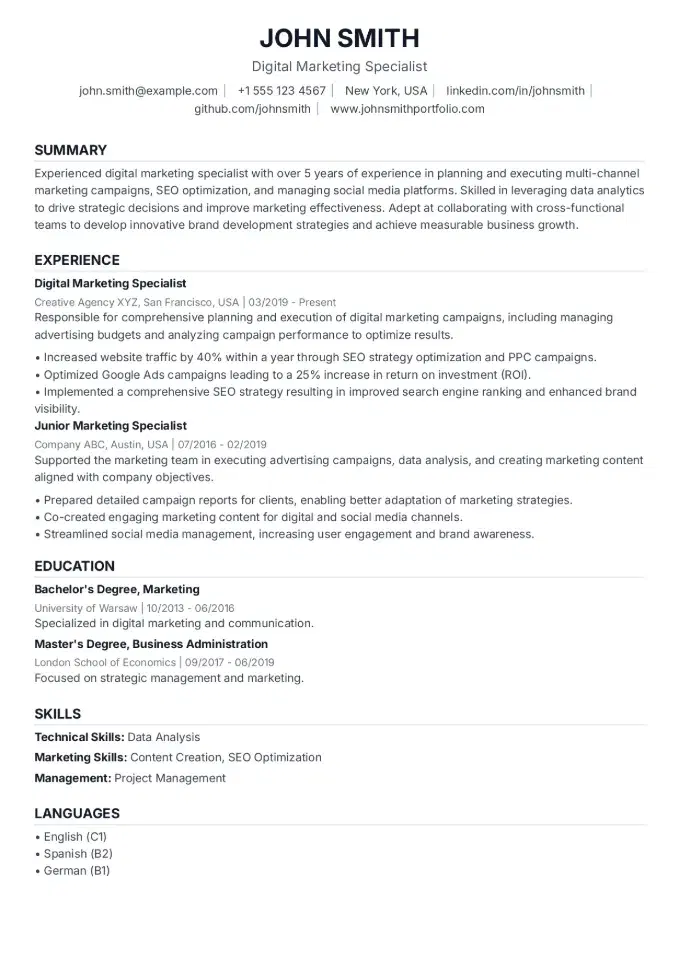
Like this layout?
Try the Essential Clean template - Click to fill it with your data
Essential CleanEducation: What to Include and What to Skip
How you present education depends entirely on where you are in your career.
Recent graduate (0-3 years out)? Lead with education after your summary. Include your degree and major, school name, graduation year, GPA if it's 3.5 or above, and any honors, relevant coursework, or activities that demonstrate applicable skills. Below that, list any internships or part-time work.
Established professional (5+ years)? Move education to the bottom. Degree, major, school - that's it. GPA drops off. Your track record speaks louder than your transcript.
Certifications are worth listing regardless of career stage, as long as they're from recognized bodies and relevant to the role. PMP or PMI-ACP for project management, CPA or CFA for finance, SHRM for HR, Six Sigma for operations - include these with the issuing organization and year earned. A short online course without a formal exam or credential generally isn't worth a line on a US resume unless it's directly tied to a specific requirement in the posting.
Resume Mistakes That Will Get You Rejected
These are the errors that quietly eliminate candidates before anyone has a conversation.
1. Sending the same resume everywhere
A generic resume is a low-conversion resume. Each application deserves at least 10-15 minutes of tailoring - update the summary, reorder bullets to front-load the most relevant experience, and match keywords to this specific job posting.
2. No numbers, anywhere
Vague claims are forgotten. "Improved customer satisfaction" means nothing without a number. What was the CSAT score before and after? By what percentage did it improve? Quantify wherever you honestly can - volume, dollars, percentages, team size, time saved.
3. Including a photo, age, or personal details
US resume convention is strictly professional. No photo, no date of birth, no marital status, no nationality. These details create legal exposure for employers and signal that you're unfamiliar with American hiring norms.
4. "References available upon request"
It's filler - everyone knows references are available. Cut this line and use the space for something that actually helps your case.
5. Functional or skills-based resume format
Hiring managers and ATS systems in the US expect a reverse-chronological format. Functional resumes (grouped by skill rather than employer) are widely associated with candidates hiding gaps or thin experience. Stick with reverse-chronological unless you have a very specific reason not to.
6. Typos and inconsistent formatting
A single typo signals carelessness. Inconsistent date formats, mismatched fonts, or ragged spacing signal poor attention to detail - exactly what employers don't want. Proofread twice, then have someone else read it.
7.4 sec
average time a recruiter spends on first review of a resume (The Ladders eye-tracking study)
Final Checklist Before You Apply
Run through this before submitting each application:
- Resume is one page (two if you have 10+ years of relevant experience)
- Professional summary tailored to this specific role (2-4 sentences)
- Work experience bullets lead with strong action verbs and include numbers
- Keywords from the job posting are naturally included
- No photo, no personal details beyond name, email, phone, LinkedIn, and city/state
- Education and certifications appropriate to your career stage
- No "References available upon request"
- Saved as a PDF (unless the application portal specifies otherwise)
- Proofread by at least one other person
CVCompose lets you build a clean, ATS-ready resume for free - pick a template, fill in your information, and download a PDF that's formatted to parse correctly and look professional on screen. No design work required.
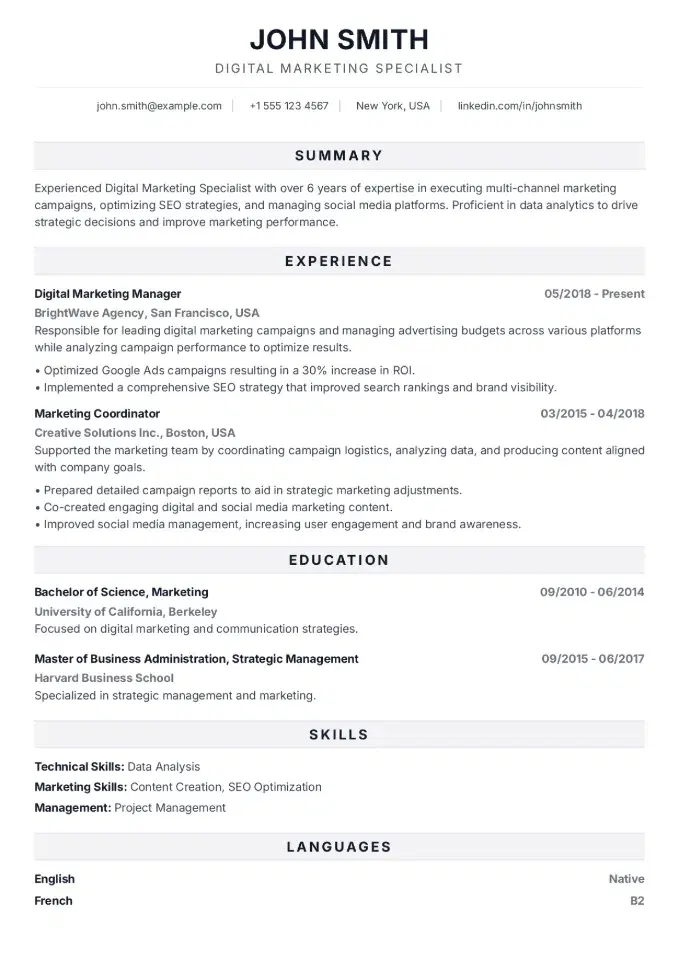
Like this layout?
Try the Bold Pro template - Click to fill it with your data
Bold Pro