You're applying for a job at a US company. The posting says "submit your resume." You have a document you've been using for years - two pages, professional headshot in the corner, full contact details, a thorough account of every role you've held. You hit send.
And you hear nothing.
This happens constantly to candidates coming from outside the US - and sometimes to Americans who have spent time working abroad. The problem is not your experience. It's the format. A document that looks polished and complete by European standards can trip every alarm a US recruiter has, before they read a single bullet point.
This article breaks down exactly what separates a CV from a resume, when each applies, and how to make the switch quickly.
98%
of Fortune 500 companies use ATS to screen applications before a human reviewer ever sees them (Jobscan, 2025)
What Is a CV - and Who Actually Uses One in the US?
In the United States, "CV" stands for curriculum vitae and refers to a very specific type of document: a comprehensive record of your academic credentials, research output, publications, presentations, grants, and professional appointments. It has no page limit. A tenured professor's CV might run twenty pages. It is the norm in:
- Academic and faculty positions
- Medical and clinical roles
- Scientific research and laboratory work
- Fellowship and grant applications
- Certain government and international agency roles
If a US job posting does not explicitly ask for a CV, you are expected to submit a resume. Sending a CV where a resume is expected does not come across as thorough - it reads as unfamiliarity with the American job market.
When people outside the US say "CV," they usually mean what Americans call a resume. This mismatch causes real problems when international candidates apply across borders.
What Is a Resume - and Why Is It the Default?
A resume is not your professional biography. It is a targeted sales document. Its only job is to answer one question for the hiring manager: is this person worth fifteen minutes of my time?
US resume conventions are tight:
- One page for candidates with fewer than ten years of experience. Two pages are acceptable for senior professionals with directly relevant history. Every line must justify its existence.
- No photo. Under EEOC guidelines, employers cannot make hiring decisions based on appearance, age, or race. A photo on your resume doesn't help you - it puts the hiring manager in a legally uncomfortable position. Many HR teams are trained to flag applications that include one.
- No personal details beyond contact info. No date of birth, no marital status, no nationality. Name, professional email, phone number, LinkedIn URL, and city/state are all you need. Full street address is unnecessary and an avoidable privacy risk.
- Achievement-led bullet points. Every entry in your work history should lead with what you accomplished, backed by numbers wherever possible. Responsibilities are table stakes - your competition has similar ones. What sets you apart is what actually happened.
- Tailored to the role. The same document does not go to every employer. At minimum, your summary and the ordering of your bullet points should reflect the specific language of the job description. ATS systems score keyword density before any human touches your file.
CV vs Resume: Side-by-Side
| Feature | Resume (US / Canada) | CV (US academic / Europe) |
|---|---|---|
| Length | 1-2 pages | No limit (often 3-20+) |
| Photo | Never | Varies by country |
| Personal details | Name, email, phone, city/state | Varies; often more extensive |
| Purpose | Targeted pitch for one specific job | Full professional and academic record |
| Bullet style | Achievements with metrics | Responsibilities, publications, grants |
| Tailoring | Required for each application | Often static |
| When used in US | Almost every private-sector job | Academia, medicine, research, grants |
Cover Letter: Still Worth It?
In the US, the cover letter's role has narrowed significantly. Most large employers process applications through ATS portals where a cover letter may not even be uploaded as a readable document. Many recruiters skip it entirely unless something flags their attention.
That said, it is not dead. Three situations where it still matters:
- The posting explicitly requests one. If they ask, send one. Not doing so is an immediate mark against you.
- You are applying directly to a person - a hiring manager, a founder, someone you've been referred to. In that context, a well-written note dramatically raises your chance of getting a response.
- You are making an unusual application - a career change, a gap in your timeline, applying from a different country. The cover letter is your place to frame the narrative before a recruiter draws the wrong conclusion.
A US cover letter is short: three paragraphs, no longer than half a page. Open with a hook - a specific reason you're right for this role, not "I am pleased to apply for..." Lead with value, not enthusiasm.
70%
of US recruiters don't read the cover letter if the resume doesn't meet the baseline requirements (Jobvite)
How to Convert a European CV Into a US Resume
If you have a CV built for the European market and need to apply to a US employer, here is a practical, step-by-step process:
1. Remove the photo.
No exceptions. It does not matter how professional it looks.
2. Strip out personal details.
Date of birth, nationality, marital status, full home address - all of it goes. Keep name, email, phone, LinkedIn, and city/state.
3. Cut to one page.
Focus on the last ten years. For each role, keep three to four bullet points - the ones with the strongest numbers and clearest outcomes. If a bullet doesn't have a number, either add one or cut it.
4. Rewrite responsibilities as achievements.
"Responsible for managing client relationships" becomes "Managed 18 enterprise accounts totaling $4.2M ARR, maintaining 94% retention over three years." The question to ask for every bullet: so what happened?
5. Remove any data consent or GDPR clause.
This is a European legal requirement that means nothing in the US context and looks out of place.
6. Tailor to the job posting.
Read the description carefully. Identify the five to eight phrases the employer uses repeatedly - the skills, tools, and competencies they keep coming back to. Make sure those phrases appear naturally in your resume. Don't keyword-stuff; do make sure the vocabulary matches.
If you want to skip the manual reformatting, CVCompose offers resume templates designed specifically for the US market - single-column, ATS-tested, and built without the personal detail fields that don't belong on an American application. Start from your existing content and rebuild it into the right format in minutes.
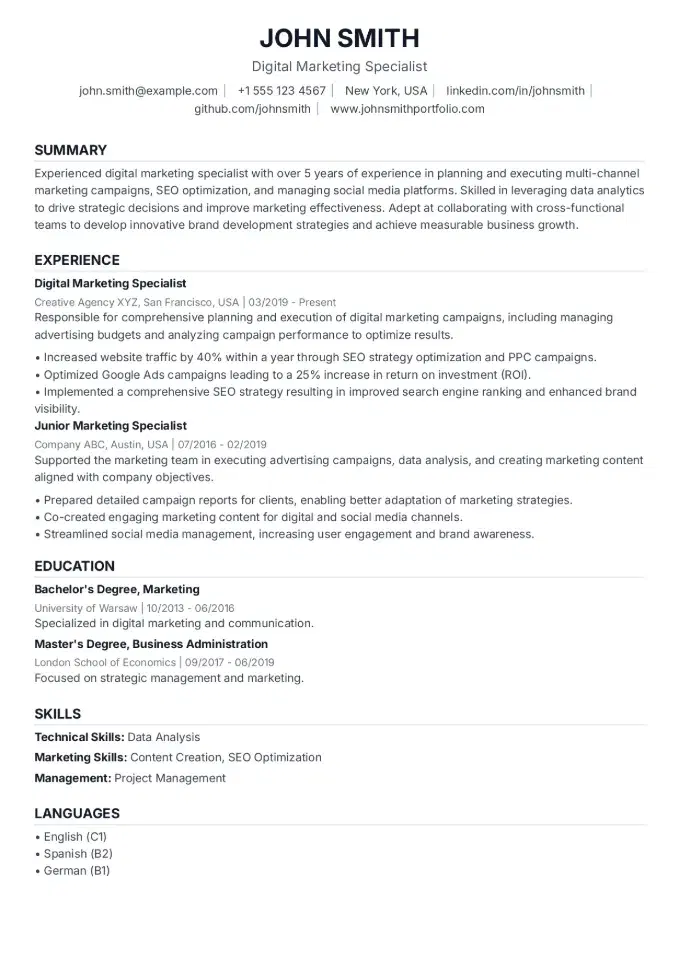
Like this layout?
Try the Essential Clean template - Click to fill it with your data
Essential Clean